Artificial Intelligence, often called AI, is no longer a futuristic concept. You already use artificial intelligence every day — when Google shows search results, when Netflix recommends movies, or when tools like ChatGPT answer your questions. But many people still ask a simple question: what is artificial intelligence, and why is it so important today?
In this guide, you will clearly understand the meaning of artificial intelligence, how it works, its types, real-world examples, advantages, risks, and its future. This article is written for beginners, without complex technical language.
What Is Artificial Intelligence?
Artificial intelligence is a branch of computer science that focuses on creating machines or software that can think, learn, and make decisions like humans.
In simple words, artificial intelligence allows machines to:
- Learn from data
- Understand information
- Solve problems
- Improve performance over time
Unlike traditional software that follows fixed rules, AI systems can adapt and make decisions based on patterns and experience.
Artificial Intelligence Definition (Simple)
Artificial intelligence is the ability of a machine to perform tasks that normally require human intelligence, such as learning, reasoning, and problem-solving.
How Does Artificial Intelligence Work?
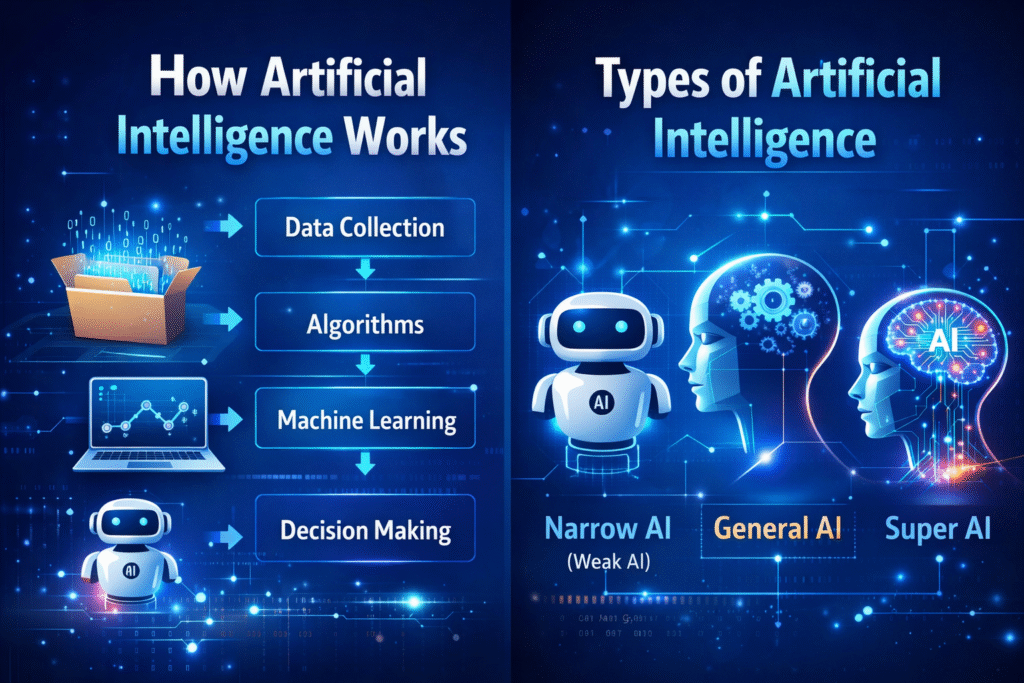
Many beginners think AI is magic, but in reality, it works in a logical way. Artificial intelligence works using data, algorithms, and learning models.
Here’s a simple explanation of how AI works:
- Data Collection
AI systems need data. This data can be text, images, videos, or numbers. - Algorithms
Algorithms are step-by-step instructions that tell the machine how to process data. - Machine Learning
The AI learns from data patterns and improves its accuracy over time. - Decision Making
Based on learning, the AI system makes predictions or decisions.
For example, ChatGPT analyzes large amounts of text data and predicts the best possible response to your question.
Types of Artificial Intelligence
Artificial intelligence is generally divided into three main types.
Narrow AI (Weak AI)
Narrow AI is designed to perform a specific task.
Examples of Narrow AI:
- ChatGPT
- Google Search
- Siri and Alexa
- Recommendation systems
Most AI tools we use today fall under this category.
General AI
General AI refers to machines that can think and reason like humans across different tasks.
Currently:
- General AI does not exist
- It is still under research and development
Super AI
Super AI is a theoretical concept where machines become more intelligent than humans.
This type of artificial intelligence exists only in research papers and science fiction and raises ethical concerns.
Real-World Examples of Artificial Intelligence
Artificial intelligence is already part of our daily life. Some common examples include:
- Smartphones: Face recognition and voice assistants
- Healthcare: AI helps detect diseases from medical images
- Business: Chatbots and data analytics tools
- Content Creation: AI tools for writing, images, and videos
- Transportation: Self-driving cars and traffic prediction
These examples show that AI is not future technology — it is present technology.
Why Is Artificial Intelligence Important Today?
Artificial intelligence plays a crucial role in modern society and business.
Key Reasons AI Is Important:
- Automates repetitive tasks
- Saves time and cost
- Improves accuracy and efficiency
- Helps businesses make data-driven decisions
- Enhances customer experience
Because of these benefits, artificial intelligence is rapidly adopted across industries.
Advantages and Disadvantages of Artificial Intelligence
Like any technology, artificial intelligence has both pros and cons.
Advantages of Artificial Intelligence
- High speed and accuracy
- Works 24/7 without fatigue
- Reduces human error
- Handles large data efficiently
Disadvantages of Artificial Intelligence
- Job displacement concerns
- Data privacy risks
- High initial cost
- Dependence on quality data
Understanding both sides helps in using AI responsibly.
Artificial Intelligence vs Human Intelligence
Artificial intelligence and human intelligence are very different.
| Aspect | Artificial Intelligence | Human Intelligence |
|---|---|---|
| Speed | Very fast | Slower |
| Creativity | Limited | High |
| Emotions | None | Strong |
| Learning | Data-based | Experience-based |
AI supports humans, but it cannot replace human creativity and emotions.
Is Artificial Intelligence Dangerous?
Artificial intelligence itself is not dangerous. The risk depends on how humans use it.
Common Concerns:
- Misuse of data
- Bias in AI models
- Over-automation
When used ethically and responsibly, artificial intelligence becomes a powerful tool for progress.
Future of Artificial Intelligence
The future of artificial intelligence looks promising.
Expected developments include:
- Smarter AI assistants
- AI-powered business automation
- Personalized learning systems
- Improved healthcare diagnosis
AI will not replace humans completely, but it will change how we work and live.
Frequently Asked Questions (FAQ)
What is artificial intelligence in simple words?
Artificial intelligence means teaching machines to think and learn like humans.
Who invented artificial intelligence?
The term artificial intelligence was introduced by John McCarthy in 1956.
Is artificial intelligence replacing humans?
No. AI is designed to assist humans, not replace them entirely.
Is artificial intelligence safe?
Yes, when developed and used responsibly.
Can beginners learn artificial intelligence?
Yes. Beginners can start with basic AI concepts and tools like ChatGPT.
Conclusion
Artificial intelligence is transforming the world faster than ever before. From daily smartphone usage to advanced business applications, AI is everywhere. Understanding what artificial intelligence is helps you stay prepared for the future.
As AI technology continues to grow, learning about it is no longer optional — it is essential. In upcoming articles on GearTechOne, we will explore how AI tools like ChatGPT can help bloggers, businesses, and professionals work smarter.